
How to be so attractive that even robots fall for you
Your next customer might ask ChatGPT, Google or another AI assistant who to hire. Here’s how to build an online presence that helps humans, search engines and AI understand why your business deserves to be in the answer.
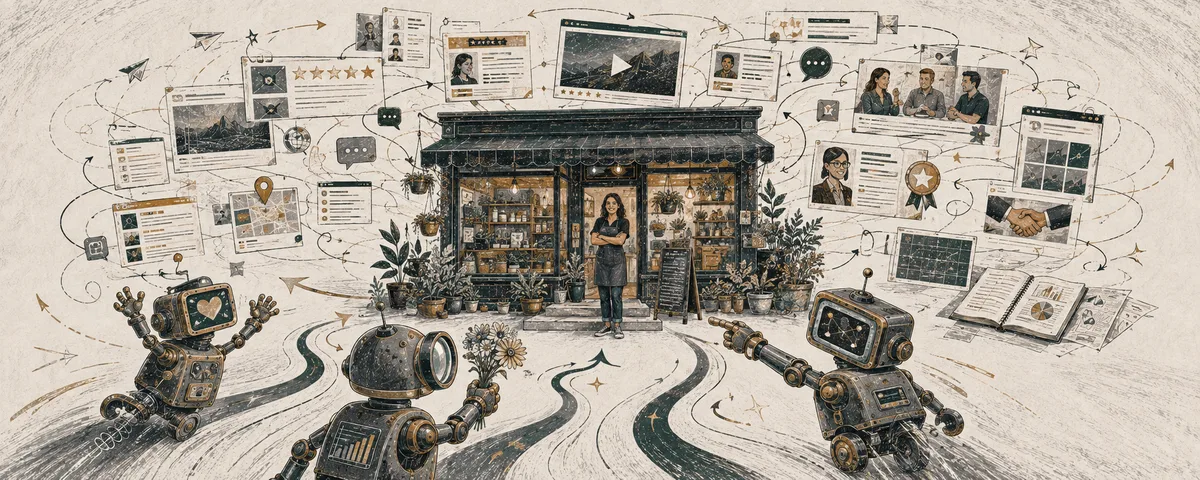
There was a time when getting found online mostly meant getting Google to like you.
Then social media arrived. Then Google Maps. Then TikTok started behaving suspiciously like a search engine.
And now people are asking ChatGPT and other AI assistants things like:
“Who is a good electrician near me?”
“Find me a dentist who is good with nervous patients.”
“Who should I hire for relaxed family photos that don’t look like we’re running for local council?”
Welcome to the new internet.
Your potential customers aren’t always searching for your business anymore. They’re describing their problem and asking a machine who can solve it.
Which raises an interesting question: Does the internet know enough about your business to recommend you? And perhaps more importantly: Does it understand what makes you different?
Your next customer might never search for your business name. They might simply describe the business they wish existed.
This isn’t another article about stuffing “best dentist Brisbane” into a webpage 47 times until Google develops Stockholm syndrome.
This is about building an online presence that makes your business understandable, useful, credible and visible wherever people — and machines — look for answers.
And AI can help you do a surprisingly large amount of the work.
First: stop thinking about “ranking on ChatGPT”
There is already an emerging industry selling businesses various flavours of GEO, AEO, AI SEO and “LLM optimisation”. Some of it is useful. Some of it is SEO wearing a fake moustache.
The fundamental idea is much simpler.
You want the internet to contain clear, consistent and credible evidence about who you are, what you do, who you help, where you operate, what you’re particularly good at, why people trust you and what you know.
That information shouldn’t exist exclusively on your homepage. Ideally, evidence of your expertise exists across your website, Google Business Profile, articles, social profiles, videos, industry publications, directories, communities, reviews, collaborations and other credible places online.
Think of it as your digital reputation, not merely your website.
Three businesses walk into an AI prompt...
Sparky Sam
Sam is an electrician. His website currently says: “Providing quality electrical solutions with exceptional customer service.” Which is impressive because it manages to say almost nothing using eight words.
Sam actually specialises in older Brisbane homes. He knows switchboard upgrades inside out, regularly installs EV chargers and is excellent at explaining electrical problems to homeowners who have absolutely no desire to become amateur electricians.
Dr Priya
Priya owns a dental clinic. Her website says: “Creating beautiful smiles for the whole family.” Lovely. Unfortunately, approximately 14 million other dentists appear to have had precisely the same idea.
Priya’s real strength is treating nervous adults. Her clinic explains procedures carefully, offers several options for anxious patients and has built its experience around people who have avoided the dentist for years because they’re embarrassed or frightened.
That’s interesting. “Beautiful smiles” isn’t.
Photographer Phoebe
Phoebe is a local photographer. Her Instagram is gorgeous. Her website has approximately nine words on it.
Phoebe specialises in family photography for parents who hate posed family photography. She knows how to work with toddlers who have decided pants are oppression, partners who “hate having their photo taken”, dogs who refuse to look at the camera and children who suddenly need a snack the second the shoot begins.
That’s a position. And positioning is where this whole game starts.
Step 1: work out what you want to be found for
Before creating 87 blog posts with AI, please don’t.
More content isn’t automatically better. Instead, start with the customer. Ask AI to help you explore situations, not just keywords.
For Sam, don’t ask: “Give me SEO keywords for electricians.” Try:
“Act as a homeowner in Brisbane living in a 1970s house. Give me 30 situations that would make you search for an electrician, including urgent problems, planned upgrades, confusing symptoms and questions you’d ask before hiring someone.”
Sam might discover:
- Why does my safety switch keep tripping?
- Does an old switchboard need replacing?
- Can my house support an EV charger?
- Why do my lights flicker when the aircon turns on?
- How much does a switchboard upgrade cost?
- Do I need an electrician to install a ceiling fan?
- Is this electrical problem dangerous?
For Priya:
“Imagine you’re 38 and haven’t visited a dentist for seven years because you’re terrified and embarrassed about your teeth. What would you privately Google or ask an AI assistant before you felt comfortable booking?”
- Will a dentist judge me for bad teeth?
- What happens if I haven’t been to the dentist in ten years?
- Can I ask the dentist to stop during treatment?
- What options exist for dental anxiety?
- Does the first appointment have to involve treatment?
- How painful is a root canal actually?
For Phoebe:
“I’m a parent with two children under five. I want family photos but hate stiff, posed photography. What concerns would I have before choosing a photographer?”
- What happens if my toddler won’t cooperate?
- What should we wear for family photos?
- Can we bring our dog?
- How long should a family photo session be?
- What if my partner hates photos?
- Are candid family photos actually candid?
- What’s the best time of day for photos with small children?
Same AI. Three completely different universes. That’s the point.
Don’t ask AI what you should talk about. Give it a customer worth thinking about first.
Step 2: steal your content strategy from your customers
Not literally. Please don’t rifle through Janet’s handbag.
Instead, look at what customers are already asking publicly.
Use Google Trends
Use Google Trends to compare topics, see how interest changes over time and identify seasonal patterns. Test assumptions rather than deciding everything from a keyword list.
Use AlsoAsked
AlsoAsked maps the questions people see in Google’s “People Also Ask” results. Those branches can become FAQs, article sections, full articles, Reels, YouTube videos and sales-objection content.
Use AnswerThePublic
Use it to expand a broad subject into the questions and phrases people search around it. Look for patterns rather than treating every result as an assignment.
Use SparkToro
Use SparkToro to understand where an audience spends attention: websites, social accounts, YouTube channels, podcasts, platforms and topics. Your audience probably doesn’t spend its evenings refreshing your corporate blog. Sorry.
Step 3: go lurking on Reddit
Reddit can be an extraordinary research tool because people talk differently when they’re asking other humans for advice.
Google: “dentist anxiety treatment options”. Reddit: “I haven’t been to a dentist since 2018 and I’m absolutely shitting myself. How bad is this going to be?”
Guess which one tells you more about the customer’s actual emotional state.
Search relevant communities for problems, complaints, recommendations, “is this normal?” posts, “how much should this cost?” discussions, regrets, things people wish they’d known and questions people feel silly asking businesses directly.
Do not copy Reddit. Use it as ethnographic research.
Step 4: turn FAQs into an actual knowledge base
Every business has questions it answers repeatedly. Most businesses answer them privately. Over. And over. And over. Your inbox is basically hiding your content strategy from you.
Collect questions from:
- Emails.
- Phone enquiries.
- Sales calls.
- Quotes.
- Instagram DMs.
- Reviews.
- Reception staff.
- Customer objections.
- Support requests.
- Google Business Profile questions.
- Reddit and community discussions.
Then answer them properly. Don’t turn every pricing question into “Contact us today for a personalised quote!” Explain what affects price, typical job categories, fees, what helps you quote, what makes a job more expensive and how customers can avoid surprises.
Step 5: create articles people would actually send to someone
The internet does not desperately need “10 reasons why regular dental check-ups are important.” We have enough.
Instead, write the article your customer desperately wants at 11:47 pm.
- Priya: “I haven’t been to the dentist in 10 years. What happens when I finally go?”
- Sam: “My safety switch keeps tripping. What can I check before calling an electrician?”
- Phoebe: “My partner hates having photos taken. Here’s how we survive family shoots.”
Specificity wins. First-hand experience wins. Useful opinions win. Real photographs win. Examples win. Original data wins. Stories win.
Step 6: turn one good idea into an entire content ecosystem
You do not need 30 ideas every month. You need several good ideas and an intelligent distribution system.
Say Sam writes: “7 signs your old Brisbane switchboard might need replacing.” That one piece can become:
- A detailed website article.
- Seven short social posts.
- A carousel.
- A 60-second Reel.
- A YouTube explainer.
- An email to past customers.
- Several Google Business Profile posts.
- FAQ answers.
- A checklist.
- A quote follow-up resource.
- Talking points for a podcast or local media interview.
One piece of expertise. Many formats. This is where AI becomes extremely useful.
Step 7: turn your articles into YouTube videos with Gemini Notebook
Google renamed NotebookLM to Gemini Notebook in July 2026. It is the same standalone product under the new name, and it can work from source material such as websites, PDFs, YouTube videos, audio, Google Docs and Slides. Its Video Overviews can turn notebook sources into AI-generated explainers.
1. Write one genuinely useful article.
2. Create a notebook in Gemini Notebook and add the article, supporting research, service information, FAQs and original notes.
3. Generate a Video Overview and steer it towards the audience.
4. Human-review everything, particularly health, financial or legal information.
5. Publish strategically across YouTube, article embeds, short clips, email and pre-sales resources.
Now one piece of expertise exists as text, video and potentially audio. Machines can understand it. Humans can choose how they consume it. Everyone wins. Except perhaps whoever used to spend six hours manually converting blogs into PowerPoints. Sorry, Gary.
Step 8: don’t forget Google Business Profile
For local businesses, keep business information accurate, add real photographs, collect genuine reviews and respond to them. Evidence beats adjectives almost every time.
Step 9: make sure machines can understand the boring bits
Your website should clearly state business name, services, location or service areas, contact information, opening hours where relevant, team, credentials and relevant profiles. Structured data can help search engines understand standard business information. It isn’t magic recommendation dust. It’s housekeeping.
Step 10: borrow other people’s audiences
Your website saying you’re brilliant is marketing. Someone else saying you’re brilliant is reputation.
Ask: who already has the attention or trust of the people we want to reach?
- Sam: builders, architects, EV dealers, solar installers, property managers, renovation creators and local media.
- Priya: psychologists, GPs, parenting publications, local community organisations, health podcasts and allied-health practitioners.
- Phoebe: venues, family bloggers, stylists, baby brands, tourism organisations and parenting publications.
Pitch an actual story, not “local business provides quality solutions”. Expertise + relevance + timing gives another publisher something worth covering.
Step 11: create things worth citing
Instead of only writing opinions, create original information: surveys, benchmarks, calculators, local guides, process documentation, before-and-after examples and annual reports.
- Sam: “The 10 electrical problems we found most often in 100 Brisbane homes built before 1980.”
- Priya: “What 100 nervous dental patients told us they were actually afraid of.”
- Phoebe: “The most popular Brisbane family photo locations according to 200 shoots.”
Step 12: let your experts become people
Businesses love hiding their smartest people behind logos. Stop doing that. If Priya writes the dental anxiety article, tell readers who Priya is. Include her name, qualifications, experience, areas of expertise, why she wrote the article and other content she has contributed to.
Your experts should also show up elsewhere: LinkedIn, YouTube, podcasts, industry publications, events and relevant community discussions. Not because everyone needs to become an influencer. God help us. Because people trust people.
Step 13: social media should distribute expertise, not announce its existence
Please stop posting: “NEW BLOG 🚨 Read our latest insights!” Nobody has been waiting by the letterbox.
Instead, take the most useful thought from the article and publish it natively.
- Phoebe: “The biggest mistake parents make before family photos is telling their kids to smile.”
- Sam: “Your safety switch tripping isn’t the problem. It’s the warning.”
- Priya: “If you haven’t been to the dentist in years, please don’t apologise when you walk in.”
Each piece should be useful even if nobody clicks anything. Your content earns attention first. Traffic comes second.
Step 14: participate where the conversation already exists
This includes Reddit, Facebook groups, LinkedIn discussions, industry communities, YouTube comments and relevant forums. Be a person, not a backlink with legs.
Answer the question. Explain variables. Mention uncertainty. Help. If your profile makes it clear who you are, interested people can find you.
Step 15: use AI to find the gaps
Once you have a decent body of content, give AI your sitemap, article titles, service pages, FAQs and audience personas. Ask: “Pretend you’re choosing between this business and three competitors. What questions would you still need answered before you felt confident contacting us?”
Run the exercise separately for each customer persona. Same content. Different customer. Different gaps.
The “make robots fall for you” checklist
Be clear
Make it painfully obvious what you do, who you help and where you operate.
Be specific
“Family photographer specialising in relaxed sessions with young children” says far more than “capturing memories that last forever”.
Be useful
Answer the questions customers actually ask.
Be credible
Show experience, qualifications, reviews, examples and real people.
Be consistent
Your website, listings and profiles shouldn’t tell different stories.
Be present
Show up beyond your own website.
Be original
Publish experiences, data, opinions and expertise that didn’t already exist online.
Be human
Put names and faces behind expertise.
Be technically understandable
Use sensible site architecture, metadata and structured information.
Be worth talking about
Earn reviews, collaborations, mentions and media coverage.
So, what should you actually do on Monday morning?
Don’t attempt all of this simultaneously. You’ll create a 73-tab Notion board and achieve nothing.
Week 1: define your position
- Your three most valuable customer types.
- The problems each one has.
- What makes you particularly useful to them.
- The subjects you genuinely know more about than they do.
Week 2: collect 50 real questions
- Customer emails.
- Google.
- Reddit.
- AlsoAsked.
- AnswerThePublic.
- Reviews.
- Sales conversations.
- Your staff.
Week 3: build five cornerstone resources
- Choose five questions with genuine commercial relevance.
- Answer them extraordinarily well.
Week 4: distribute them
- Social posts.
- Short videos.
- FAQs.
- Google Business Profile content.
- YouTube material.
- Email content.
- Relevant publications and collaborators.
Every month thereafter, ask: “What are customers asking us now that they weren’t asking six months ago?” That’s your next content plan. Not “we need four blogs this month”.
The future of online visibility is probably more human than we think
AI is changing how people discover businesses. But the answer isn’t to start writing for robots. Quite the opposite.
The businesses easiest for machines to understand may also be the businesses doing the best job of communicating with people: clear positioning, useful expertise, real experiences, original information, trusted recommendations, consistent business information and actual humans willing to put their name behind what they know.
So yes: optimise for the robots. Make Google understand you. Give AI systems plenty of context. Structure your website properly.
But don’t become obsessed with gaming whichever acronym the marketing industry invents next Tuesday.
Build a business with a digital presence so useful, specific, credible and interesting that people keep talking about it.
Then even the robots might develop a little crush.
Key takeaways
The useful bits, in one place
- Don’t optimise only for a business name. Build content around the problems and situations customers actually describe.
- Use AI to research audiences, interrogate content gaps and repurpose expertise — not to manufacture hundreds of generic articles.
- Use tools such as Google Trends, AlsoAsked, AnswerThePublic, SparkToro and Reddit to reveal what customers care about and the language they use.
- Turn repeated customer questions into useful FAQs, articles, videos and social content.
- One strong article can become an entire content ecosystem, including social posts and Gemini Notebook-assisted video content.
- Build visibility beyond your website through collaborations, communities, reviews, earned media and original research.
- Make authorship and expertise clear. Businesses have logos; expertise comes from people.
- Good technical SEO and structured business information still matter, but they’re the foundations rather than the whole strategy.
- The goal isn’t to trick AI into recommending you. It’s to create enough credible evidence online that recommending you makes sense.

References
- 01Google Search Central — Creating helpful, reliable, people-first content
- 02Google Trends
- 03AlsoAsked — People Also Ask research
- 04AnswerThePublic
- 05SparkToro audience research
- 06Reddit community discussions as audience-research inputs
- 07Google Gemini Notebook Help — supported sources
- 08Google — NotebookLM is now Gemini Notebook
- 09Google Gemini Notebook Help — Video Overviews
- 10Google Business Profile Help
- 11Google Search Central — LocalBusiness structured data
Related resources
Keep reading
Most small businesses don't need a beautiful website. I said what I said.
AI-built websites are often criticised for looking generic. Fair enough. But for most small businesses, the more important question is whether the website builds trust, answers customer questions and generates work.
Small business? Stop wasting money following Google’s recommendations
Google Ads increasingly wants you to automate more, broaden your targeting and let AI make decisions. That can work brilliantly when there’s enough data and budget. For a small local business, it can also be a very expensive experiment.

Next step
Find your own bottleneck.
Take The Marka Score for a clearer view of what is working, what is leaking and what should happen next.