
Most small businesses don't need a beautiful website. I said what I said.
AI-built websites are often criticised for looking generic. Fair enough. But for most small businesses, the more important question is whether the website builds trust, answers customer questions and generates work.
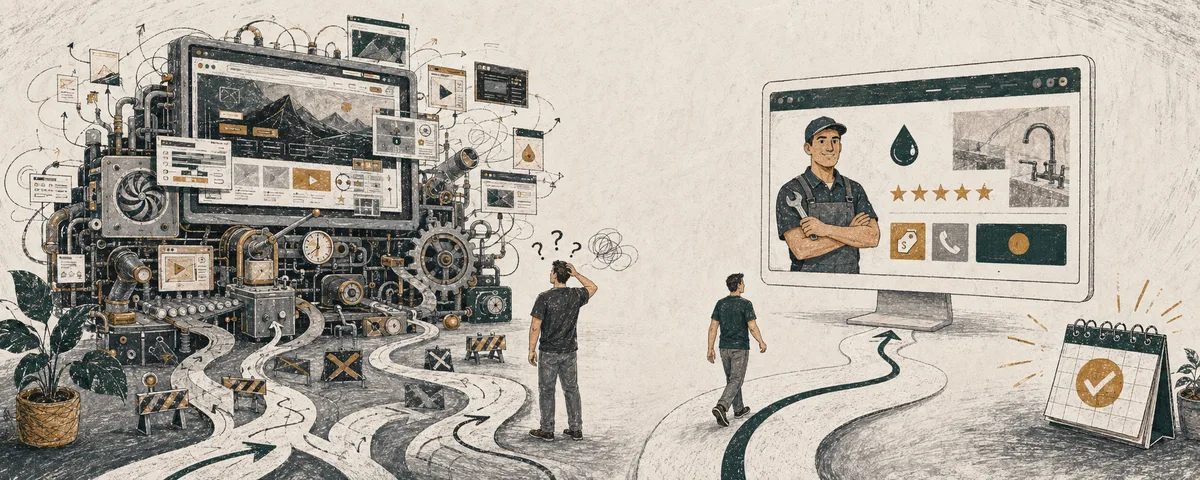
Everyone's complaining that AI websites all look the same. They're right. But they're asking the wrong question.
If your plumber's website looks like AI built it, would you hire them less than the plumber whose website answers your questions, shows real reviews, explains their pricing and lets you book online in under a minute?
Probably not.
Because customers don't buy websites. They buy confidence. And somewhere along the way, we've confused originality with effectiveness.
Customers don't buy websites. They buy confidence.
AI doesn't have a style. It has defaults.
Lately, there's been a lot of discussion about ‘AI slop’ — the flood of generic-looking websites, logos and content generated with little thought or direction.
The criticism is fair.
Open five AI-built websites and you'll often see the same fonts, the same layouts, the same stock imagery and the same predictable copy.
But here's what most people miss.
AI isn't creating bad design. It's revealing bad direction.
Ask vague questions and you'll get average answers. Give AI no strategy and it'll fall back to its defaults.
That's not really an AI problem. It's a direction problem.
An experienced designer, strategist or developer can guide AI towards something that feels completely aligned with a brand. That means defining the visual system, tone of voice, customer journey, content structure, interaction patterns and business goals before asking AI to produce anything.
The technology is capable of far more than people realise.
Practical tip: don't start with a website prompt
Before asking AI to design or build anything, define:
- Who the customer is.
- What they need to know.
- What action you want them to take.
- What should make them trust the business.
- The brand’s visual and verbal rules.
- What absolutely does not belong on the website.
The quality of the direction usually determines the quality of the output.
But here's the unpopular opinion...
Not every business needs a website worthy of a design award.
A local electrician doesn't need cinematic animations. A plumber doesn't need a homepage that belongs in an art gallery. A hairdresser doesn't need an interactive experience that wins international design competitions.
They need customers to trust them.
As a customer, I don't care if my plumber has the world's most beautiful website. I care that I can quickly find:
- What they do.
- Where they work.
- What their services cost, or how to request a quote.
- Photos of previous work.
- Reviews from happy customers.
- How to contact or book them.
That's it.
A website is a business tool before it's a design project. Too many businesses have been sold the opposite.
The best website isn't necessarily the prettiest one. It's the one that helps the business grow.
What a small business website actually needs to do
1. Explain the offer
A visitor should understand what the business does within seconds.
2. Establish trust
Reviews, real project examples, credentials, guarantees and clear contact details often matter more than visual effects.
3. Answer the obvious questions
Pricing, service areas, availability, process and FAQs remove friction before the customer even makes contact.
4. Make the next step easy
Call. Book. Request a quote. Send an enquiry. Whatever the action is, it should be obvious.
5. Work properly
It should load quickly, work well on mobile, be accessible, be easy to find in search and connect properly with the rest of the business.
Everything beyond that should earn its place.
We've seen this movie before.
Remember when Canva launched? Suddenly, people who weren’t designers could create presentations, social posts, flyers and marketing materials themselves. Design became far more accessible.
And professional designers didn't disappear. The good ones evolved.
The value shifted away from simply knowing how to operate design software and towards judgement, ideas, brand thinking and creative direction.
AI is the next chapter of the same story. It’s making websites easier to build. It’s making software easier to prototype. It’s making marketing easier to produce.
Most importantly, it’s lowering the cost of turning an idea into something real.
People with great ideas but limited budgets can launch businesses that might previously have stayed in notebooks. That’s not the death of creativity. That’s more people getting access to the tools required to create.
AI isn't replacing designers. It's changing what clients should pay them for.
If you're a designer or developer, AI isn't necessarily your competition. Generic work is.
If something can now be produced in minutes using a repeatable prompt, it's going to become harder to charge premium rates purely for production. But that doesn't make skilled people less valuable. It makes judgement more valuable.
The value is moving towards:
- Strategy.
- Customer understanding.
- Brand positioning.
- Creative direction.
- Experience design.
- Technical architecture.
- Conversion thinking.
- Original ideas.
- Knowing what not to build.
AI can generate options. It still needs someone to decide which option is right. That’s a very different skill.
Good design still matters
None of this means design is irrelevant. Quite the opposite. Good design makes things easier to understand. It creates trust. It improves usability. It communicates quality.
But good design isn't synonymous with expensive design. And it certainly isn't synonymous with adding more things.
Sometimes the best design decision is removing half the homepage. Sometimes it’s replacing an animation with a clear call-to-action. Sometimes it’s putting the phone number exactly where the customer expects it.
For a local business, those decisions can be far more commercially valuable than creating something nobody has ever seen before.
That's exactly how we use AI at The Marka
We don't use AI because we want websites that all look the same. We use it because we'd rather spend our clients' budgets thinking than repeating.
AI can help accelerate production. That gives us more time to understand the business, clarify the offer, refine the messaging, improve the customer journey and make better strategic decisions.
It means a business that doesn’t need a fully bespoke, design-heavy digital experience doesn’t have to pay for one. And a business that does need something distinctive can spend more of its budget on the parts where human creativity and judgement make the biggest difference.
That’s the opportunity. Not cheaper work. Smarter allocation of effort.
The question we should really be asking
The conversation around AI websites tends to focus on one question:
Can you tell AI made this?
I'm much more interested in another one:
Did it work?
Did the customer understand the offer? Did they trust the business? Did they make an enquiry? Did they book? Did the website help the owner grow?
Because the goal has never been to create the most beautiful website. The goal is to create the right website for the business. And those are two very different things.
Maybe the future of web design isn’t about making every website look unique. Maybe it’s about making good digital experiences accessible to far more businesses.
I think that's a future worth building.
Key takeaways
The useful bits, in one place
- AI-built websites can look generic, but poor direction is often the bigger problem.
- Small businesses don’t always need highly bespoke or design-heavy websites.
- A website should first build trust, answer questions and make it easy for customers to act.
- AI is lowering production costs in much the same way Canva lowered barriers to design.
- Designers and developers aren’t becoming irrelevant; their value is moving towards strategy, judgement, originality and specialised expertise.
- AI should reduce repetitive work, not replace strategic thinking.

References
- 01Opinion piece based on industry observation and The Marka’s approach to AI-assisted strategy and website delivery.
Related resources
Keep reading
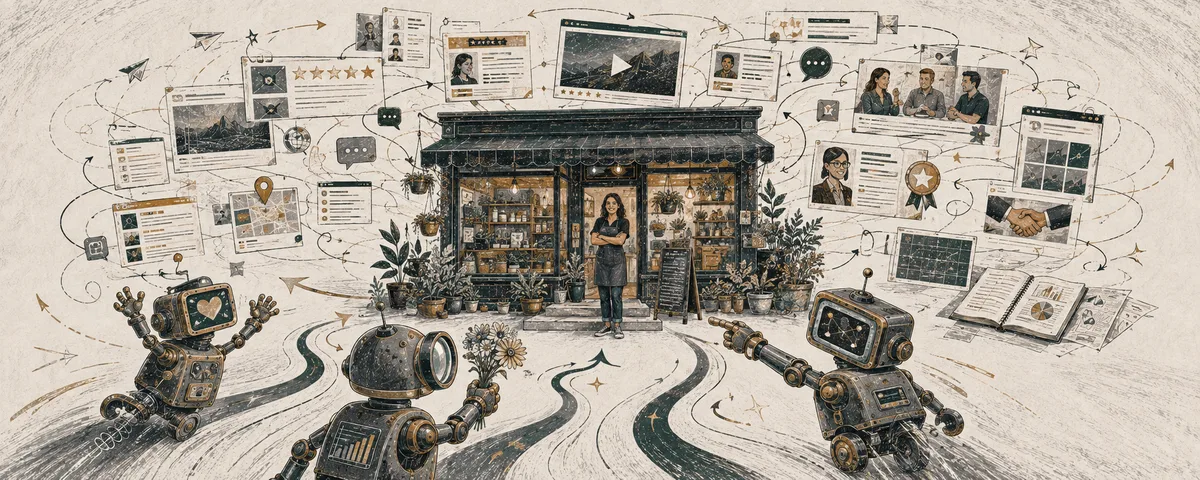
How to be so attractive that even robots fall for you
Your next customer might ask ChatGPT, Google or another AI assistant who to hire. Here’s how to build an online presence that helps humans, search engines and AI understand why your business deserves to be in the answer.
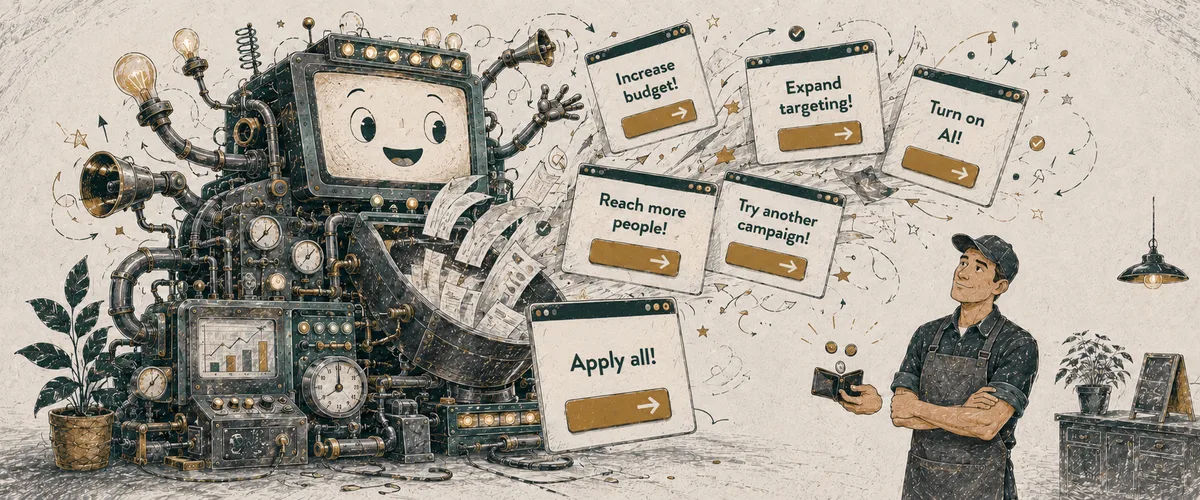
Small business? Stop wasting money following Google’s recommendations
Google Ads increasingly wants you to automate more, broaden your targeting and let AI make decisions. That can work brilliantly when there’s enough data and budget. For a small local business, it can also be a very expensive experiment.
Next step
Find your own bottleneck.
Take The Marka Score for a clearer view of what is working, what is leaking and what should happen next.